

High claimed lumens do not guarantee a usable H7 headlight beam. Importers should inspect optical alignment, beam distribution, thermal stability and installation fit before comparing suppliers.
Technical diagram: what to compare
Original inspection schematic: LED emitting position → headlamp reflector or projector → wall-test light distribution → on-road validation. Mark the original reference beam, cutoff position where applicable, hotspot and stray light on the same test surface. A wall test alone cannot establish road legality or full photometric compliance.
Practical evaluation workflow
- Confirm the exact H7 bulb and headlamp assembly, including retention hardware and dust-cover clearance.
- Use the same vehicle or lamp, mounting position, supply voltage, distance and camera exposure for both baseline and LED sample.
- Compare beam position, useful illumination, hotspot, glare above the intended cutoff and left/right consistency.
- Record current, power and brightness behavior after warm-up, not only at startup.
- Check the applicable local headlamp approval and road-use requirements. An H7 base does not by itself make an LED retrofit legal.
LEDVEDA model reference
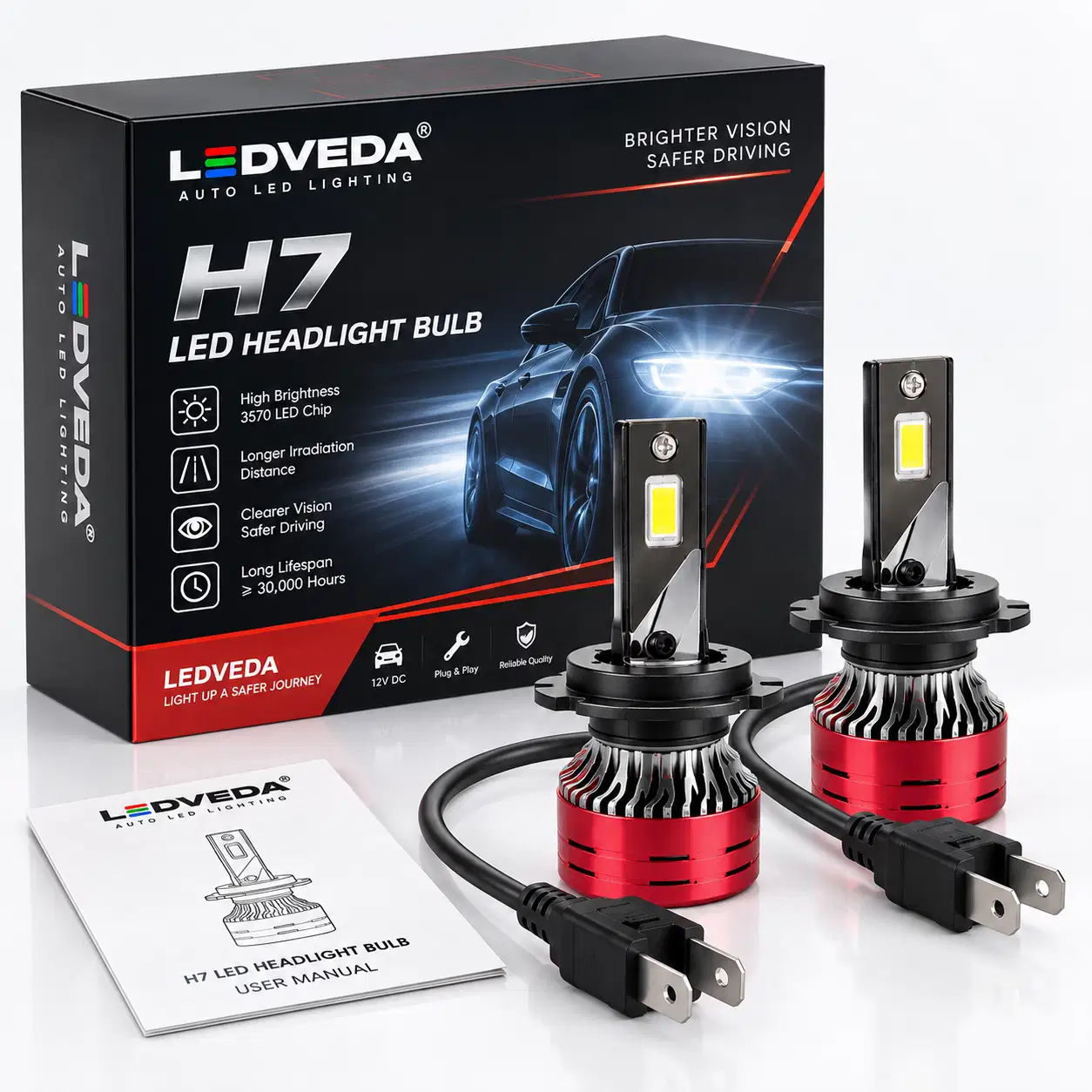
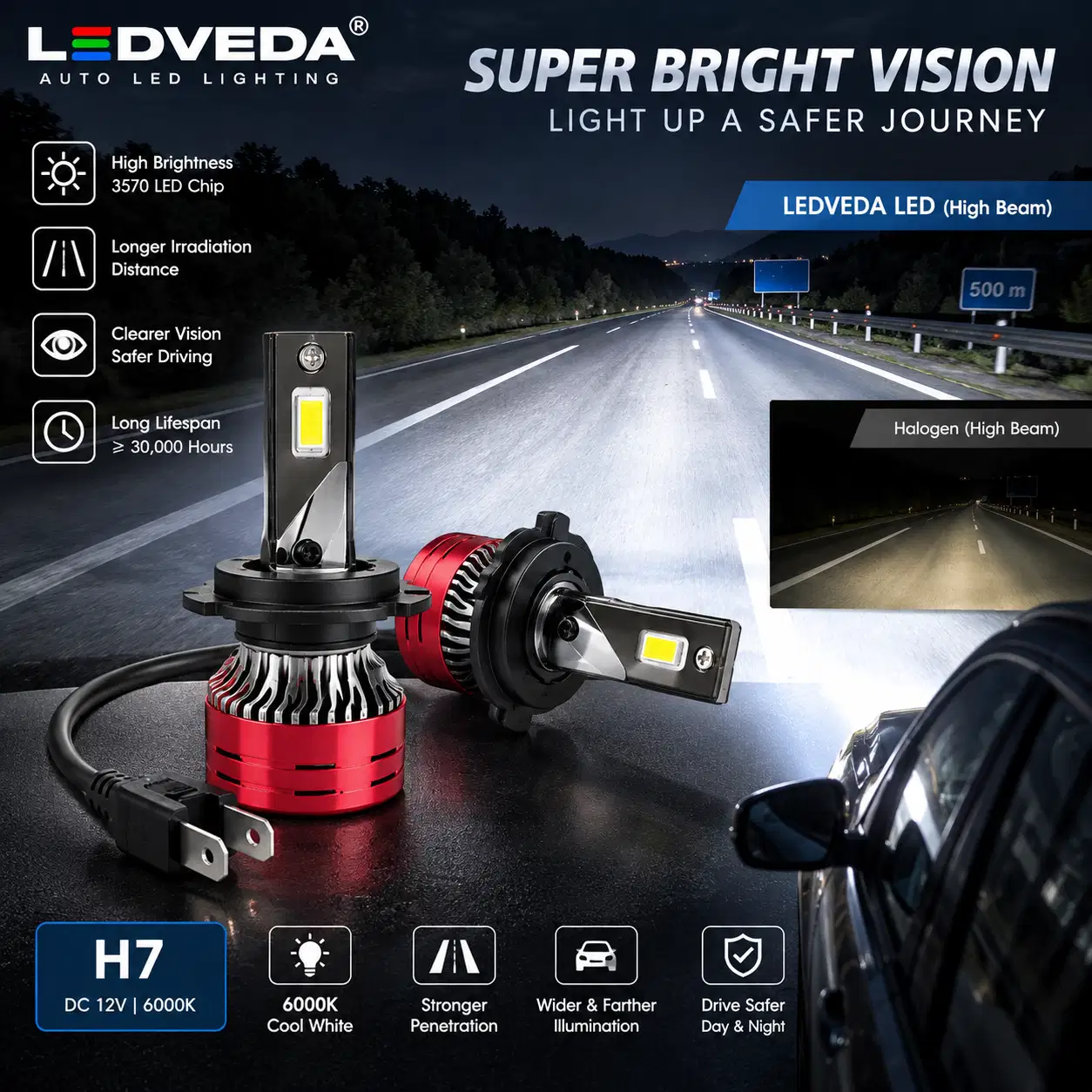
LEDVEDA H7 LV-12APro is specified as 12 V DC, 20 W, 1800 lm, 6000 K and 2 × 3570 LED chips. These are product-sheet values, not independently verified photometric test results. Confirm production tolerance and the target headlamp application before quoting. See the H7 B2B product guide and quality control checklist.
Repeatable beam comparison protocol
Use the same complete headlamp assembly for every candidate bulb. Fix the lamp height, distance to the test wall, supply voltage, camera position and exposure. Start with a known reference lamp and mark its alignment. Replace only the bulb, then record whether the light distribution shifts, whether bright patches appear above the intended cutoff, and whether the beam has dark zones. Some headlamp designs do not exhibit the same cutoff shape; do not apply a projector-style criterion indiscriminately.
Record measurements separately from subjective impressions. Electrical power in watts is not optical output in lumens, and neither number alone proves road visibility. A laboratory photometric test requires appropriate instrumentation, angular measurements and a documented method. Do not publish simulated beam images as actual LEDVEDA test results.
Mechanical and thermal acceptance checks
- Check the mounting flange seats fully and the LED emitters have the intended orientation.
- Verify heat sink, fan and wiring clearance with the dust cover installed where applicable.
- Observe input current and illumination after thermal stabilization.
- Test left and right lamp consistency and any vehicle error detection behavior.
- Document the exact lamp assembly and local road-use regulatory status.
Use the RFQ checklist to specify test conditions before requesting competing supplier samples. Any performance comparison must distinguish manufacturer specifications from independently measured data.
LEDVEDA H7 LV-12APro product images
Original website product assets; these are not certified beam-pattern test results.
H7 sample acceptance checklist for purchasing teams
| Inspection | What to record | Why it matters |
|---|---|---|
| Base and installation | H7 mounting position, retainer clearance and connector fit | Prevents installation failures |
| Electrical input | Supply voltage, stabilized current and measured input power | Checks the exact sample rather than relying on advertised ratings |
| Beam comparison | Same headlamp, same wall distance, same camera settings and reference bulb | Supports repeatable comparisons |
| Thermal stability | Operating temperature and brightness change after warm-up | Reveals thermal-related output changes |
| Market requirements | Applicable local road-use approval and labeling requirements | A bulb’s base type alone does not establish road legality |
FAQ
Does higher lumen output always improve road visibility?
No. Optical distribution, alignment and glare control are critical.
Is a sharp cutoff guaranteed by an H7 LED bulb?
No. The result depends on the complete headlamp optical system and installation.
How should buyers compare samples?
Use identical test conditions and document electrical, thermal and beam observations.
Request H7 samples for evaluation
For a wholesale H7 evaluation, share your headlamp type, target market, voltage and annual volume using the LEDVEDA inquiry form. For brand projects, review our private-label production process.